
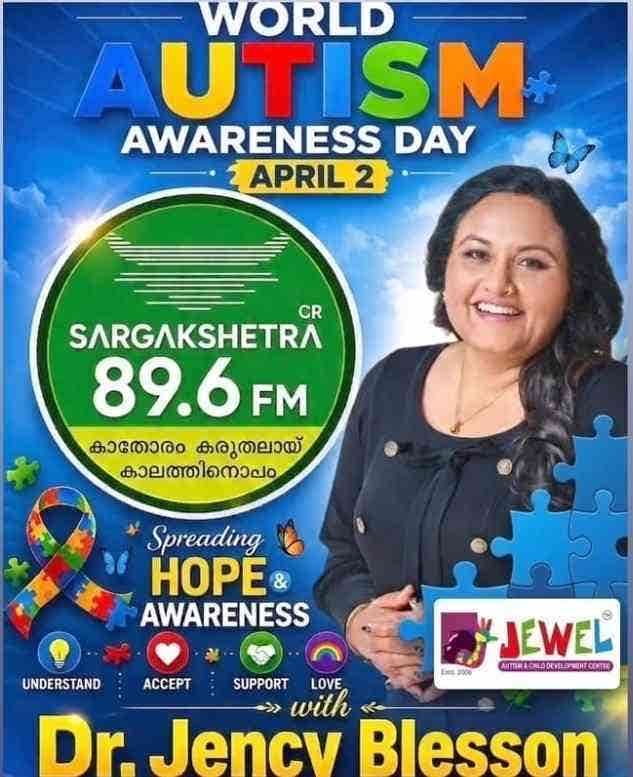
World Autism Awareness Day highlights the importance of understanding autism and supporting children in their developmental journey. Increasing awareness helps families identify early signs and take timely action, which can make a significant difference in a child’s life.
As part of a special awareness program on 89.6 FM Sargakshethra, Dr. Jency Blesson, a specialist in Autism and Child Development with over 18 years of experience, shared key insights into autism, its rising trends, and the role of early intervention.
What is Autism?
Autism, or Autism Spectrum Disorder (ASD), is a developmental condition that mainly affects communication, behavior, and social interaction. It is largely influenced by genetic factors and is characterized by certain classical symptoms such as repetitive behaviors and difficulties in communication.
In earlier years, autism was estimated to affect about 1 in 200 children. However, recent observations suggest that the number has increased significantly, with approximately 1 in 32 children being identified on the spectrum. This sharp rise highlights the growing need for awareness and early diagnosis.
Virtual Autism vs Real Autism
Interestingly, around 30–40% of the cases seen today are referred to as “Virtual Autism” rather than real autism.
Virtual Autism is often linked to environmental factors, especially excessive screen exposure and lack of social interaction during early developmental stages. The positive aspect is that, if identified early by parents, it can often be corrected with timely intervention and lifestyle changes.
Understanding Developmental Milestones in Children
Monitoring a child’s developmental milestones is crucial for early detection of any delays, including autism.
At 1 Year
A child should be able to say at least 5–7 meaningful words independently.
At 2 Years
Should combine two words (e.g., “want water,” “give milk”).
Should have a vocabulary of around 60–70 words.
Most importantly, the child should be able to express needs verbally.
At 3 Years
Should speak in three-word sentences.
Vocabulary may expand to around 300 words.
At 4 Years
Should be able to form longer sentences (4–5 words).
Begin narrating experiences (e.g., describing events or things they saw).
It’s important to note that language is only one aspect of development. Play skills, learning ability, and cognitive development are equally important indicators.
Can Children with Autism Improve?
A common question parents ask is: “How far can a child with autism progress?”
The encouraging answer is that children with autism often have no intellectual limitations once their core challenges—communication, behavior, and language—are addressed.
A well-known example often associated with autism traits is Elon Musk, showing how individuals on the spectrum can achieve remarkable success.
Strengths and Learning Patterns in Autism
Children with autism often display unique strengths:
- Strong focus and concentration on specific interests
- Ability to excel deeply in areas they are passionate about
- High levels of dedication when properly guided
However, they may not perform equally well in all subjects. For example, a child might excel in English but struggle with subjects like history or geography.
This is why customized learning approaches, including tailored curriculum and teaching methods, are essential.
Importance of Mainstream Schooling
Whenever possible, children with autism should be included in mainstream schools.
Why?
Because they are excellent learners through observation and imitation. Being around other children provides them with role models to copy behaviors, communication styles, and social interactions—helping them improve significantly.
The Role of Early Intervention
Early identification and intervention are key to helping children reach their full potential.
- Reduces developmental delays
- Improves communication and social skills
- Helps children integrate better into society
Parents play a crucial role in observing early signs and seeking professional guidance.
Conclusion
World Autism Awareness Day reminds us that awareness is the first step toward meaningful change.
With expert guidance from professionals like Dr. Jency Blesson and awareness initiatives through platforms like 89.6 FM Sargakshethra, parents and caregivers can better understand autism and support children at the right time.
Early recognition, proper guidance, and a supportive environment can help every child move forward with confidence.