
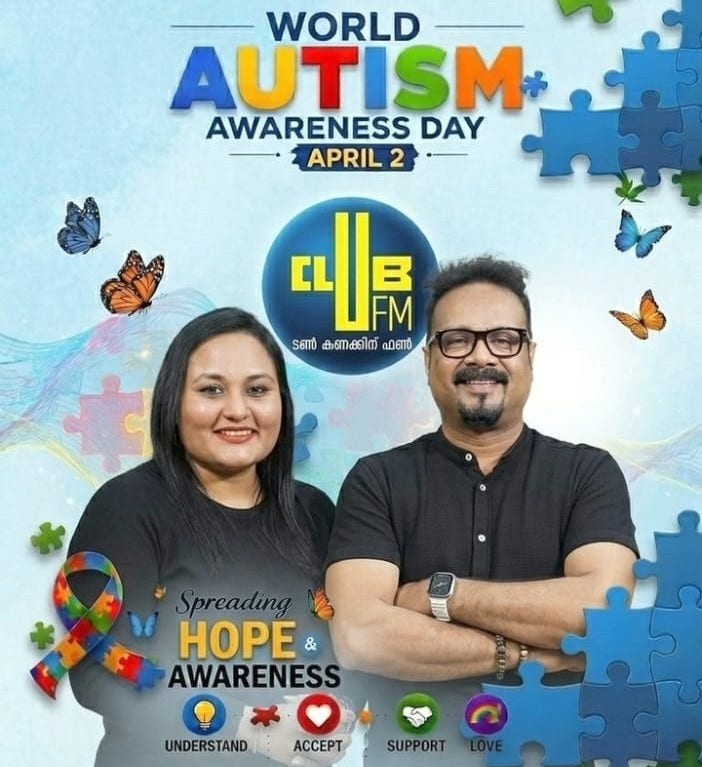
World Autism Awareness Day is a reminder of how important it is to understand autism and to support the rights and development of children on the autism spectrum. Creating awareness helps families recognize early signs and take the right steps at the right time.
As part of this special program on Club FM 104.8, we hear from Dr. Jency Blesson, Director of Jewel Autism and Child Development Centre, who brings over 18 years of experience in child development and autism care.
Understanding the Early Signs of Autism
Autism can often be identified at a very early stage—typically between 18 months and 2 years. Some common signs parents should watch for include:
- A child who was speaking well suddenly showing a delay or regression in speech
- Not responding when their name is called
- Reduced eye contact with parents or others
- Spending more time in their own world
- Lack of interest in interacting with family members or other children
- Repetitive behaviors or actions
Recognizing these early indicators can make a significant difference in a child’s developmental journey.
What Should Parents Do First?
Parents should begin by observing their child’s language milestones:
- At 1 year: The child should say around 5–6 words
- At 2 years: The child should combine two words to express needs
- At 3 years: The child should form simple three-word sentences
If there is a noticeable delay or regression:
- Check the child’s environment and level of interaction
- Pay attention to communication patterns at home
If concerns continue, it is important to consult a child developmental team to assess:
- Language development
- Cognitive abilities
- Social interaction skills
A Common Mistake Parents Make
One of the biggest mistakes parents make is relying only on speech therapy when they notice speech delay.
While speech therapy is important, it is not the complete solution. Children with Autism Spectrum Disorder (ASD):
- Can see, hear, and feel
- But face challenges in how the brain processes information
A multidisciplinary approach is essential, including:
- Sensory Integration Therapy
- Occupational Therapy
- Education and structured language training
Why Early Intervention is Critical
The early years are crucial because around 80% of brain development happens between 0–4 years.
- If autism is identified between 1.5 to 3 years, improvements can be seen within 3–6 months
- Delayed identification may require longer treatment and can affect schooling
For example:
If a child is brought in at around 7 years, treatment may take 1.5 to 2 years, depending on the severity.
This clearly highlights the power of early diagnosis and early intervention.
Understanding Virtual Autism
In today’s digital age, a growing concern is virtual autism.
This refers to:
- Children below 3.5 years
- Who are exposed to more than 2 hours of screen time daily
This can lead to:
- Language delays
- Communication difficulties
- Behavioral changes
These symptoms may resemble autism, but virtual autism is not traditional autism.The positive news is:
- With the right professional support
- At the right time
These symptoms can often be completely reversed.
Can Autism Be Cured?
A common question among parents is whether autism can be completely cured.
According to Dr. Jency:
Children with autism are often intellectually strong
Their main challenges are in:
- Communication
- Language
- Social interaction
- Sensory processing
With:
- The right therapy
- At the right age
- From the right professionals
Many children can be supported to integrate into mainstream environments.
Even globally known personalities like Elon Musk, who has Asperger’s Syndrome, show that individuals on the spectrum can achieve remarkable success.
A Message to Parents
Parenting plays a crucial role in a child’s development.Children are:
- Emotionally, mentally, and physically dependent on parents
- In need of consistent care and presence
Every parent should ensure:
- Proper nutrition
- A stress-free and healthy environment
- Being emotionally and physically available for the child
One powerful reminder shared by Dr. Jency:
If parents cannot dedicate time to their child, it becomes difficult to support their development effectively.