
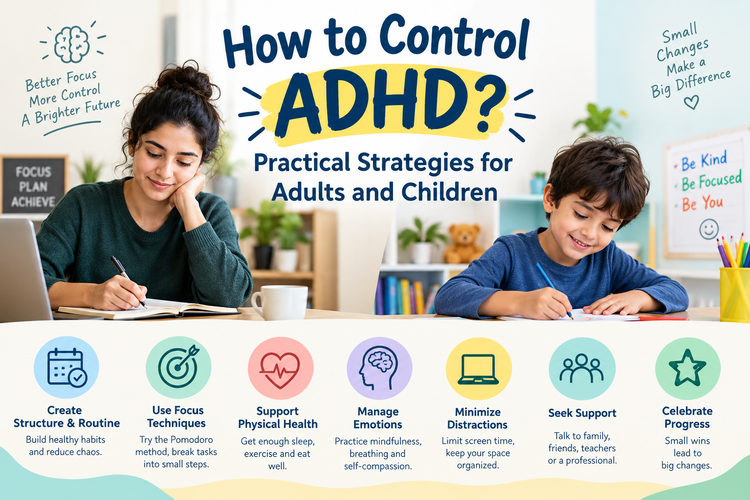
Do you find it hard to finish even simple tasks? Or does your child struggle to sit still and focus on homework? If that sounds familiar, ADHD may be part of the picture.
Many people ask the same question: how do I control ADHD? Here is the honest answer. There is no cure, but you can manage the symptoms, and many people do it very well. All it takes is the right treatment, daily habits and support. This guide shows you where to start.
What Does "Controlling" ADHD Really Mean?
It doesn't mean forcing yourself to concentrate harder. ADHD is a neurodevelopmental condition, not a character flaw. Symptoms usually appear before age 12 and change over time. Children tend to struggle more with hyperactivity and impulsivity, while adults more often deal with memory slips, restlessness and trouble holding focus. It's also common: US estimates put lifetime ADHD in adults aged 18 to 44 at just over 8%.
So control really means building systems that work with your brain instead of fighting it.
4 Myths Worth Dropping Right Now
- "Medication is the only fix." It helps many people, but it isn't a cure, and it works best alongside other strategies.
- "I'm lazy or not smart enough." Not true. Adults with ADHD often invent very clever workarounds.
- "A professional will sort it all out." Professionals guide you. Your daily habits do the heavy lifting.
- "I'll always struggle like this." With practice, good strategies can become second nature.
What Does Professional Treatment Look Like?
Most plans combine behavior therapy, medication where it's appropriate, and practical coaching. For adults, that often means talking therapy such as CBT alongside medication management. Children are a little different. The CDC recommends behavior therapy, including training for parents, as the first step for kids under 6, before any medication. From age 6 onward, behavior therapy together with medication is the usual approach. If you're exploring this for your child, behavioral therapy and clinical psychology support are good places to start asking questions.
8 Daily Strategies That Actually Help
Small, repeatable habits beat big promises. Try a couple, keep what sticks.
- Write tomorrow's plan tonight. Check it three times a day: morning, midday and early evening. Cluster similar tasks, like answering all emails at once, instead of scattering them.
- Give everything a home. A tray by the door for keys, wallet and sunglasses saves you ten frantic minutes every morning.
- Become a clock-watcher. Time can feel slippery with ADHD, so use visible clocks and timers. For every 30 minutes you think a task needs, add 10. Write appointments down 15 minutes early.
- Shrink the big task. "Clean the living room" is vague. "Collect the dishes" isn't. Set a timer for 10 to 15 minutes and do just one small piece. If you've got energy left, go again. If not, stop and come back tomorrow.
- Tame distractions. Turn off notifications, face your desk toward a wall and try noise-canceling headphones or instrumental music. Keep a notepad for stray ideas so they don't derail you.
- Capture and echo. Ask for the agenda before a meeting, and repeat instructions back out loud. Fidgeting? Squeeze a stress ball or take a quick walk during breaks.
- Keep money simple. Go for online banking, automatic payments and reminders. To curb impulse buys, shop with a list, track a running total and avoid the places that tempt you.
- Learn to say no. Impulsive yeses fill your calendar fast. Check your schedule before agreeing to anything new. Committing to less and delivering it beats the opposite every time.
The "Boring" Habits That Make Everything Easier
Here's the thing nobody wants to hear: sleep, food and movement change how ADHD feels day to day.
- Exercise. It's one of the quickest ways to ease restlessness and poor focus. Pick something you'll enjoy, ideally outdoors. Calmer options like yoga or mindful walking help build control over attention and impulses.
- Sleep. A 2025 research review found about 80% of people with ADHD struggle with sleep loss. Skip late caffeine, keep a steady sleep and wake time (even on weekends) and build a quiet wind-down routine.
- Food. Diet doesn't cause ADHD, but poor eating can make symptoms worse. Smaller meals through the day, protein at every meal and fiber-rich whole grains all help.
- Mindfulness. Short sessions can improve focus and lower impulsivity. Start with a few minutes, since sitting still is hard at first, and build up slowly.
Helping a Child With ADHD at Home
Kids need the same structure, just with more support from you. Keep routines predictable. Give one clear instruction at a time. Notice and praise good behavior more often than you correct bad behavior. Parent training is a big part of what makes behavior therapy work. Some children also need help with daily skills, sensory needs or emotional regulation, which is where occupational therapy can come in.
Not sure what's going on with your child? An early assessment can bring clarity. Jewel's page on ADHD is a helpful starting point, and its Child Guidance Clinic offers assessment and therapy for emotional, behavioral and developmental challenges.
Therapy Techniques That Support Children With ADHD
Beyond home routines, therapists draw on a toolkit of proven techniques. You don't need all of them at once, but it helps to know what the terms mean.
- Structured routines and sensory diet charts. Fixed times for waking, meals, homework and bed, shown on a picture schedule. A sensory diet chart adds planned movement and sensory breaks through the day, like jumping, pushing or carrying something heavy, to keep the body regulated. The evidence is still mixed, so let an occupational therapist design it. Jewel's sensory integration team works on this.
- Calming strategies and trigger spotting. Notice what comes before a meltdown: noise, a sudden change, hunger, tiredness. Prevent what you can, and teach calming tools like slow breathing or a quiet corner for the rest.
- Tracking behaviors. Jot down what happened before, what your child did and what followed. Patterns show up within a couple of weeks and tell you whether a strategy is really working.
- Shaping, behavior modification and fading. Shaping means rewarding each small step toward a goal, not just the finished result. Behavior modification means consistently reinforcing what you want to see more of. Fading is the exit plan: slowly reducing prompts and rewards so your child manages on their own. ABA-based programs use all three.
- Frame of reference. Good therapists plan from a guiding model, such as a behavioral or sensory integration approach. Ask yours which one they use and why.
- Task-oriented activities. Start with your child's needs and interests. Short tasks, small steps, a visible timer and a little choice all encourage greater engagement.
- ADL and IADL training. Activities of daily living (ADL) are basics like dressing, brushing teeth and eating. Instrumental activities (IADL) are bigger life skills, such as preparing a snack, handling pocket money or using a phone.
- Social skills training. Taking turns, listening and reading a friend's mood can all be taught. Social skills training and play therapy make the practice feel like fun.
- Environmental modifications. A quiet, tidy study corner away from the TV, with only what's needed on the desk, removes a lot of temptation.
- Academic involvement and study patterns. Stay in touch with the teacher and ask about a front-row seat, written instructions and extra time. At home, study in blocks of 15 to 20 minutes with a movement break between them, at the same time and place each day. Remedial education can help close learning gaps.
- Specialist guidance. ADHD often overlaps with learning difficulties, anxiety or developmental delay. A professional assessment sorts out which is which and what your child needs first.
Parents Need Support Too
Raising a child with ADHD is tiring, and it's okay to admit that. You're a big part of the treatment, so looking after yourself isn't optional.
- Parent education. Learning why your child acts the way they do helps you see impulsive behavior as a skill gap, not defiance. That alone can lower the temperature at home.
- Parent coping strategies. Pause before reacting, share the load with your partner or family, protect your own sleep and find other parents who understand. A calm parent is a consistent parent.
- Stay involved in therapy. Ask for monthly goals and a home program. At Jewel, parents can observe sessions and get home training plans, and the social work department helps families find their way around schools and services.
When Should You Get Professional Help?
Don't wait for things to fall apart. It's time to talk to a specialist if:
- Symptoms are hurting your work, studies, finances or relationships
- Your child is falling behind at school or struggling to make friends
- Strategies help a little but you still feel overwhelmed most days
- Anxiety, low mood or constant stress seem to travel with the ADHD
For children, a developmental pediatrician is a good first call. Jewel's team includes one, and you can read about developmental paediatrics on their site.
FAQs
Can ADHD be cured?
Ans- No. But with the right treatment and habits, symptoms can be controlled well enough that many people thrive at work, school and home.
Can ADHD be controlled without medication?
Ans- For some people, yes. Behavior therapy, routines, exercise, better sleep and organizational tools can make a big difference. Medication helps many others, so it's best decided with a doctor.
What's the best way to control ADHD in adults?
Ans- A mix works best: therapy, structure (planners, timers, routines), healthy lifestyle habits and support from people around you.
How do I control ADHD in my child?
Ans- Use consistent routines, clear instructions and plenty of positive reinforcement. For children under 6, behavior therapy with parent training is recommended first.
Does exercise really help ADHD?
Ans- Yes. Regular exercise can reduce restlessness and inattention, lift mood and relieve stress.
Final Thoughts
Controlling ADHD isn't about trying harder. It's about building a life with fewer traps in it: simple routines, smaller tasks, better sleep and the right support at the right time. Start with one strategy this week. If your child needs more than home strategies, the team at Jewel Autism Centre in Kottayam, Kochi and Dubai is happy to talk it through. You can book an appointment whenever you're ready.