
PROMPT THERAPY
What is prompt Therapy ?
PROMPT therapy (Prompts for Restructuring Oral Muscular Phonetic Targets) is a tactile-kinesthetic speech therapy method that uses physical touch cues on a patient's face to manually guide the movement of their jaw, lips, tongue, and neck.
Developed by speech-language pathologists, this specialized approach relies on a therapist using precise pressure, timing, and placement cues to build new sensory-motor pathways in the brain, helping the individual physically feel how to correctly shape speech sounds.
Rather than just relying on visual or auditory mimicry, PROMPT reshapes muscle movements to treat speech production disorders, making it highly effective for individuals of all ages including toddlers and adults who experience complex communication challenges such as Childhood Apraxia of Speech, dysarthria, autism, or neurological damage from a stroke.

The Core Pillars of the Approach
A comprehensive description of PROMPT therapy involves three fundamental areas:
1. Tactile-Kinesthetic Guiding (The Hands-On Cues)
Speech requires the rapid, subconscious coordination of more than 100 muscles across the jaw, lips, tongue, vocal cords, and respiratory system. If a brain-to-mouth connection is disrupted as seen in conditions like Childhood Apraxia of Speech or Dysarthria the message gets lost.
How it works: The therapist uses specific amounts of pressure, placement, and movement on the outside of the mouth to manually shape correct speech sounds (phonemes), syllables, and full words.
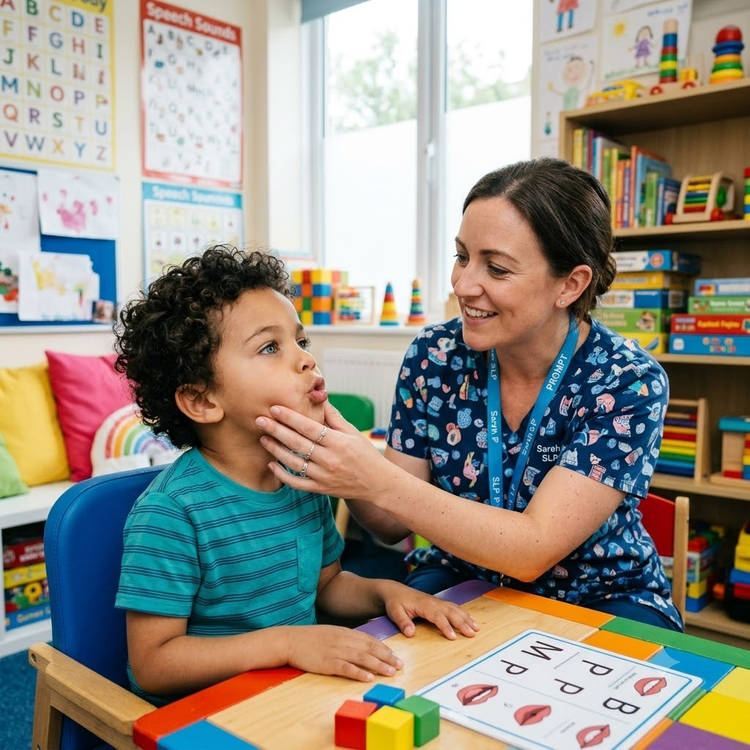
The Sensation: For example, when targeting the $/m/$ sound, the therapist might gently hold the lips together while feeling for vocal vibration, giving the child an immediate, real-time physical map of what that sound feels like.
2. The Motor Speech Hierarchy
Therapy does not just jump into complex words; it systematically works through physical developmental milestones using a strict framework:
Stage 1: Postural Support & Tone: Aligning the head, neck, and trunk.
Stage 2: Jaw Stability: Securing a controlled, stable jaw, which provides the foundation for all other mouth movements.
Stage 3: Labial-Facial Control: Building lip rounding, retraction, and closure.
Stage 4: Lingual Precision: Training the tongue to elevate, back, or groove independently of the jaw.
3. Holistic & Functional Focus
PROMPT is fundamentally built on the philosophy that speech cannot be isolated from the rest of the human experience. Every session integrates the Physical-Sensory, Cognitive-Linguistic, and Social-Emotional domains.
Play-Based Delivery: Cues are almost always embedded naturally within motivating, everyday routines—like playing with a toy farm or cooking pretend food—ensuring the targeted words have immediate functional meaning to the client.
Supporting Clear Speech with PROMPT Therapy
PROMPT (Prompts for Restructuring Oral Muscular Phonetic Targets) is an evidence-based speech therapy approach used to support children with speech and communication difficulties, including those with Autism Spectrum Disorder (ASD). It focuses on developing clear speech by guiding and shaping the movements of the jaw, lips, tongue, and face needed for accurate sound production.
PROMPT therapy uses tactile-kinesthetic cues—gentle, structured touch provided by a trained therapist—to help children understand how speech sounds are formed. This hands-on approach supports children who struggle with speech clarity, motor planning, articulation, and expressive communication.
Therapy sessions are child-centered and individualized, based on a detailed assessment of the child’s speech, oral motor abilities, and communication needs.
Parents and caregivers are actively involved and guided to support speech development beyond therapy sessions, helping children generalize skills into daily communication.
With consistent intervention, PROMPT therapy can help children develop clearer speech, improved communication abilities, and greater confidence in expressing their needs and ideas.

Core Focus Areas of Prompt Therapy

Speech Motor Planning
Supports children who struggle to plan and coordinate the movements needed for clear and accurate speech production.

Tactile-Kinesthetic Cues
Uses gentle, structured touch cues to guide jaw, lip, and tongue movements for correct sound formation.

Articulation & Speech Clarity
Helps improve pronunciation, sound sequencing, and overall speech intelligibility for effective communication.

Expressive Communication
Encourages confident verbal expression, helping children communicate needs, thoughts, and emotions more clearly.
Recognized By Major Gulf & Indian News Platforms







What Parents Say

Jake Nikhil
Jewel in Kottayam is a world-class facility with over two decades of experience in childhood development. Skilled therapists, efficient staff, and excellent management make it highly recommended for children needing developmental support. Families from across the world trust their international-standard care!

Anu Peter
"I've been taking my child to Jewel Child Development Center in Kakkanad for therapy, and the experience has been truly heartening. Finding the right support for your child can be overwhelming, but the team here makes the journey so much easier. The therapists are not only highly skilled but also genuinely bond with the kids, making the sessions feel more like guided play than clinical work. I've seen a visible shift in my child's confidence and skills since we started. They are also very transparent with progress reports, which helps us stay on track as parents. For anyone in the Kochi area looking for a supportive and professional environment for their child's growth, Jewel is definitely a place you can trust."

Adithya Baiju
Working at Jewel Autism Centre has been a truly rewarding experience. The centre provides a supportive and professional environment where both staff and children are valued with care and respect. The management is approachable, teamwork is encouraged, and there are great opportunities to learn and grow professionally.

Rena Rafic
Working at Jewel Autism Centre and Child Developmental Centre has been a meaningful experience. The center maintains a positive and supportive work environment where the focus is always on the growth and well-being of each child. The team is dedicated, compassionate, and professional, and there is good cooperation among staff members. It is a great place to learn, grow, and contribute to making a difference in children's lives.

Sussamma Mathew
Best child development center with excellent professionals.

Absheen Mathew
Such a Supportive Team.

Shiba Shiny Babu
Jewel Autism Centre, Kottayam, is undoubtedly one of the best autism treatment and support centres in India. The dedication and professionalism of the entire team are truly commendable. The staff provide excellent support and maintain clear, consistent communication with families, ensuring that parents are always informed and involved in their child's progress.
The therapists are highly trained, extremely patient, and genuinely caring in their approach. Their expertise and commitment create a positive and supportive environment for children to learn and grow.

Vihaan Kumar
I miss you. Vihaan is doing good in school. Good sitting ,Good eye contact with class teacher ,Good listening, Good group participation writing Thank you forever.