
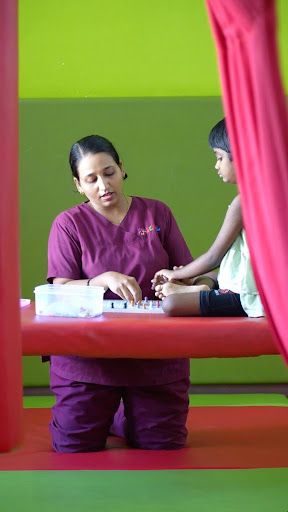
Play is often viewed as something children do simply for fun or entertainment. Parents may hear statements such as:
- “Stop playing and start learning.”
- “Play is a reward after work.”
- “Children should focus on academics.”
However, from a developmental perspective, play is not separate from learning — play is learning.
Play is one of the most important occupations of childhood. Through play, children develop:
- Cognitive skills
- Motor abilities
- Emotional regulation
- Language
- Social understanding
- Sensory processing
- Problem-solving abilities
Neuroscience and developmental research consistently show that play experiences actively shape the developing brain.
Understanding play from an occupational therapy perspective helps adults recognize that children are not “just playing” — they are building the foundation for lifelong participation and learning.
The Developing Brain and Play
During childhood, the brain undergoes rapid growth and organization.
Neural connections develop through:
- Repetition
- Exploration
- Sensory experiences
- Movement
- Social interaction
Play provides all these experiences simultaneously.
When children play, multiple brain regions become active:
🟢 Prefrontal cortex:
- Planning
- Decision-making
- Attention
🔵 Cerebellum:
- Coordination
- Timing
- Motor control
🟡 Limbic system:
- Emotions
- Motivation
🔴 Sensory processing systems:
- Touch
- Movement
- Body awareness
Repeated play experiences strengthen neural pathways.
Play Supports Sensory Development
Children learn through sensory experiences.
Play provides opportunities to experience:
- Movement
- Touch
- Visual information
- Sounds
- Body position
- Balance
Examples:
Sand play:
- Tactile input
Swinging:
- Vestibular input
Climbing:
- Proprioceptive input
Sensory experiences help organize the nervous system.
Play Supports Executive Functioning
Play helps children develop:
- Planning
- Working memory
- Flexible thinking
- Emotional control
Examples:
Pretend play requires children to:
- Create ideas
- Follow sequences
- Shift between roles
- Solve problems
These are essential executive functioning skills.
Play Supports Emotional Development
During play, children learn:
- Frustration tolerance
- Delayed gratification
- Coping skills
- Emotional expression
For example:
Building blocks that repeatedly fall over provide opportunities to:
- Manage disappointment
- Problem-solve
- Persist
Play Supports Social Development
Social play helps children learn:
- Turn-taking
- Cooperation
- Communication
- Empathy
- Perspective taking
Children gradually understand:
- Rules
- Relationships
- Social expectations
through playful experiences.
Play Supports Motor Development
Movement during play improves:
- Balance
- Coordination
- Strength
- Body awareness
- Motor planning
Activities such as:
- Running
- Jumping
- Climbing
- Throwing
help build physical foundations for participation.
Why Reduced Play Can Affect Development
When children experience limited opportunities for play, they may have fewer opportunities to develop:
- Creativity
- Problem-solving
- Emotional regulation
- Social skills
- Motor abilities
Overly structured environments may reduce opportunities for exploration.
Supporting Play at Home
🟢 Follow the child’s interests
Children learn best through meaningful activities.
🔵 Reduce pressure
Play does not always require teaching.
🟡 Allow unstructured play
Children benefit from opportunities to create their own experiences.
🔴 Encourage movement
Movement supports brain development.
The Role of Occupational Therapy
Occupational therapists use play to support:
- Sensory integration
- Motor skills
- Social participation
- Emotional regulation
- Functional participation
Play is often the primary occupation through which children learn and develop.
Final Thoughts
Play is not simply entertainment.
Play is a biological and neurological necessity that helps build the architecture of the developing brain.
Because children are not avoiding learning when they play —
they are learning in the way their brains were designed to learn.
References
American Occupational Therapy Association. (2020). Occupational therapy practice framework: Domain and process (4th ed.). American Journal of Occupational Therapy, 74(Suppl. 2).
Ginsburg, K. R. (2007). The importance of play in promoting healthy child development. Pediatrics, 119(1), 182–191.
Ayres, A. J. (1979). Sensory integration and the child. Western Psychological Services.