
OUTDOOR THERAPY
01 · A natural approach
What is outdoor therapy?
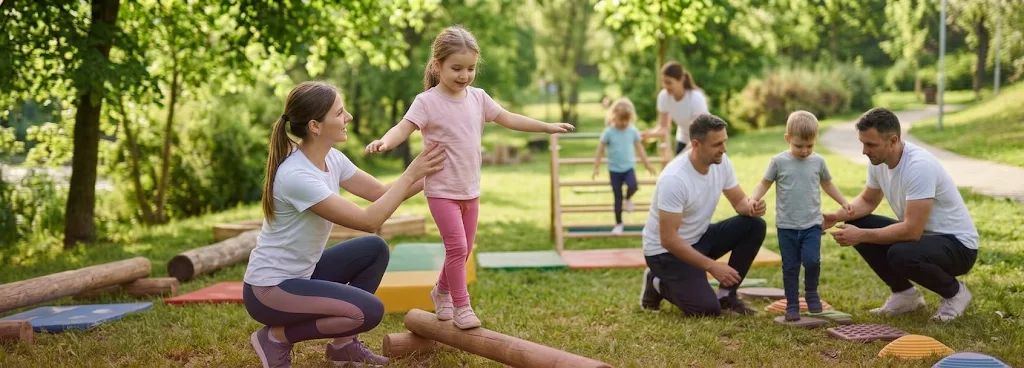
Outdoor therapy uses meaningful activities in parks, gardens, playgrounds and community settings to support a child's development. Sessions combine play, movement and purposeful interaction in environments that feel engaging rather than clinical.
Therapists observe how a child communicates, moves, regulates emotions and interacts with others in real situations. Goals are then practised through activities such as walking, balancing, collecting objects, playing a game or joining a simple group task.
02 · Why outdoors?
Benefits of learning in nature
Open, purposeful environments offer richer opportunities for attention, movement and social participation.
Natural movement
Climbing, walking, jumping and balancing support strength, coordination and body awareness.
Shared attention
Interesting spaces encourage eye contact, turn-taking and communication for a shared purpose.
Real-life practice
Children generalise skills in places such as parks, schools, shops and community spaces.
Calmer regulation
Fresh air, sensory variety and paced activity can support relaxation and emotional balance.
03 · A typical session
Playful, purposeful and individualised.
Every outdoor session is planned around the child's goals. A therapist provides support, adapts the activity and gradually encourages more independence.
- 01Connect
Begin with a shared activity and review the child's feelings and readiness.
- 02Explore
Move through a safe outdoor setting and notice interests, sensory responses and strengths.
- 03Practise
Work on chosen communication, social, motor or emotional-regulation goals.
- 04Reflect
Celebrate progress and plan simple strategies to continue the learning at home.
04 · Core focus areas
How outdoor therapy supports your child
Goals are selected after an individual assessment and may combine multiple areas of development.
Express needs and ideas
Practise requesting, commenting, listening and following directions in context.
Join shared activities
Build turn-taking, cooperation, flexible play and positive peer interaction.
Move with confidence
Support balance, coordination, strength and safe exploration of movement.
Manage everyday tasks
Plan actions, complete routines and adapt to changes in familiar environments.
05 · Who may benefit
Designed around individual needs.
Build social participation, communication and coping skills.
Use movement and purposeful play to practise attention and self-control.
Explore new actions and routines at a comfortable pace.
Experience achievable challenges and celebrate independent progress.
06 · Care team
Therapy is a partnership.
Occupational therapists, speech-language therapists, behavioural therapists and special educators may work together depending on the child's goals.
Parents are included throughout planning and receive practical ideas for continuing activities safely at home and in the community.
07 · Frequently asked questions
Common questions
For advice specific to your child, speak with our therapy team.
What happens during outdoor therapy?
A therapist plans structured activities in a safe outdoor or community setting and adapts them around the child's developmental goals.
Is outdoor therapy suitable for every child?
Suitability depends on the child's age, sensory needs, mobility, health and support requirements. An assessment helps decide whether this approach is appropriate.
What should we bring to a session?
Comfortable clothing, drinking water, sunscreen and any agreed sensory or mobility support should be brought. The therapist will provide a specific checklist.
Can outdoor therapy continue in hot or rainy weather?
Activities are adjusted for safety and comfort. Some sessions use shaded outdoor areas or move to sheltered community spaces when needed.
Ready for the next step?